Tag: #WholeFoodNutrition

  • Vitamin C

    Vitamin C

    Scurvy was a scourge for sailors during the mid-15th to mid-18th centuries when ships were dominant in global trade and warfare. No one knew that the lack of vitamin C for long periods of time would cause disease, decay and ultimately death.

    Fortunately, in 1753, James Lind, a Scottish surgeon in the Royal Navy, discovered that sailors’ scurvy could be prevented by eating citrus fruits. But it still took another 42 years for health reformers to persuade the Royal Navy to routinely give lemon juice to its sailors.

    Today, scurvy may no longer be a scourge, but low-level vitamin C deficiency is common. Because of the prevalence of chronic disease, knowledge of the body’s need for vitamin C is more important than ever.

    As the Scottish surgeon discovered, vitamin C is not made by the human body, but it is crucial to maintain optimal health, to prevent disease, and to play a big part in curing disease. 

    Vitamin C:

    Boosts the Immune System

    Vitamin C contributes to your immune defense system by supporting multiple cellular functions of your body’s adaptive immune systems. 

    Supports the Brain

    • protects against neural damage
    • promotes the healthy development of neurons and supports the formation of myelin (a soft, white material in the membrane of certain cells)
    • supports optimal neurotransmitter production
    • leads to expression of BDNF – brain-derived-neurotropic-factor (a protein)
    • may even help avoid Alzheimer’s Disease according to recent studies

    technology computer head health

    Fights Oxidative Damage in the Body

    Consuming vitamin C can increase your blood antioxidant levels by up to 30%.

    Antioxidants protect cells from free radicals, which fights inflammation.  Research has shown that chronic inflammation is associated with heart disease, diabetes, cancer, arthritis, and bowel diseases like Crohn’s disease and ulcerative colitis.

    Studies show that vitamin C is especially effective at reducing damage in the lungs. That’s why some doctors were using it in early treatment of Covid-2.  

    It is sometimes used in the form of a high dose IV to aid in recovery from surgery and illnesses like cancer.

    Boosts Collagen Production and Improves Skin

    Vitamin C helps improve the connective tissues in the entire body, including skin and bones. Studies show it may slow the aging process by protecting and improving the body’s collagen. Topical treatments are clinically shown to reduce the appearance of wrinkles, lines, and sunspots.

    Supports the Adrenals

    Chronic stress puts a strain on the adrenal glands, reducing levels of cortisol. Vitamin C replaces lost cortisol. 

    Aids in Healing Wounds

    The major function of vitamin C in wound healing is assisting in the formation of collagen, the most important protein of connective tissue.
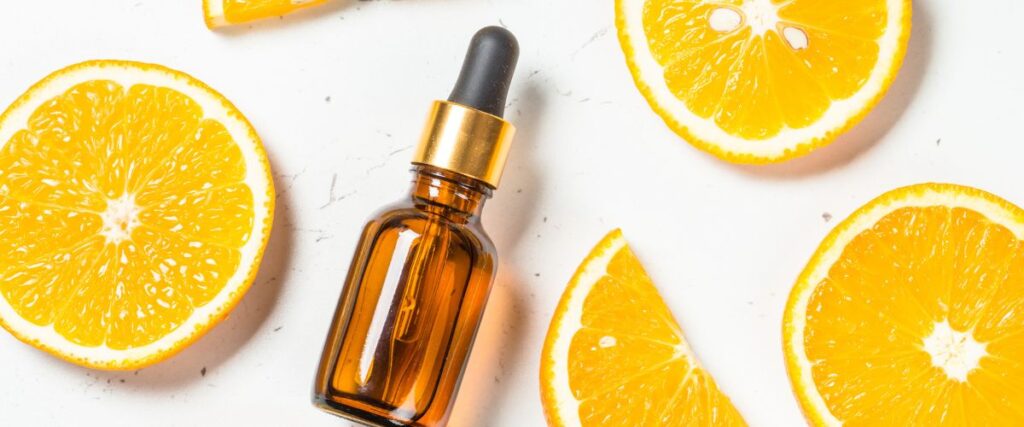

    A bottle with a dropper surrounded by slices of oranges

    Types of Vitamin C:

    Food Sources

    Vitamin C is found in many foods, and when possible, this is the best way to consume it. Eating raw vegetables and fruits will retain all its nutrients, but if you can’t digest raw vegetables, lightly steaming, sauteing, or fermenting them will preserve vitamin C’s properties. In fact, fermentation releases vitamin C, beneficial bacteria, and many other nutrients.

    Citrus fruits are high in vitamin C. One medium orange provides 70 mg of Vitamin C, while one grapefruit provides about 56 mg. Citrus fruit juices contain even higher amounts of vitamin C, with a 225 mg glass of fresh-squeezed organic orange juice providing around 125 mg of vitamin C. Be aware, though, of the high sugar content of juices, which is buffeted by eating the whole fruit. Starting your day with lemon juice squeezed into a glass of purified water is also ideal. 

    Other fruits high in vitamin C are kiwifruit, strawberries, papayas, guavas, and acerola cherries. 

    Vegetables high in vitamin C are bell peppers, broccoli, cauliflower, tomatoes, kale, and snow peas.  

    Food-based Supplements

    Linus Carl Pauling - First Day Covers from the Collection of Edward C.  Halperin, M.D., M.A. - Library Research Guides at New York Medical College

    Even with the best of diets, getting enough vitamin C from food can sometimes be difficult if not impossible. According to the Mayo Clinic, since vitamin C is water-soluble, doses up to 2,000 mg a day are considered safe, diarrhea being the most common side effect. Since we are all different, the amount each of us needs will vary. Always use bowel tolerance an indicator. 

    Dr. Linus Pauling, two-time Nobel Prize winner, published Vitamin C and the Common Cold (1970) in which he recommends taking mega-doses of vitamin C to help fight the common cold and other diseases. 

    It is rumored Pauling took between 12,000 and 18,000 mg of vitamin C daily and he lived to 93.

    How much vitamin C do You Need?

    The answer depends on who you ask. Modern research is divided, and every health expert seems to have a different opinion. 

    If you are eating enough food with vitamin C, that may be sufficient for you. With any health issue, you may want to supplement with whole-food sources.

    The Linus Pauling Institute recommends 400 mg of vitamin C daily. 

    Dr. Shelley H. Lane, OMD, L.Ac. NTP

  • Where’s the Real Beef?

    Where’s the Real Beef?

    Why Eat Beef?

    Beef provides you with protein, iron, zinc, B Vitamins – especially Vitamin B12 – iodine, essential omega-3 fatty acids, phosphorus, carnitine, coenzyme-Q-10, and calcium. Red meat protects the heart and nervous system. 

    Plants don’t provide certain nutrients that animals do, so it’s harder for vegans and vegetarians to maintain sufficient protein intake. Their diet can also be low in fat with the risk of vitamin B12, iron, calcium, and zinc deficiencies. Vegans and vegetarians need a greater reliance on supplements to achieve essential nutritional requirements.  

    You may enjoy eating beef, not only because it tastes good, but because it plays a part in your cultural food experience and is therefore part of your identity: hot dogs at a baseball game, a Hot Pastrami sandwich, a beef Shawarma, a pepperoni pizza, a Philly Cheesesteak – you get the idea. 

    Grass-fed Beef is Much Healthier than Grain-fed

    herd of white and black cows on grass field
    Photo by Lukas Hartmann

    Grain-fed cattle start out eating grass but in a short while they are herded into huge feedlots where they are fed GMO corn and GMO soy until they are brought to market. According to the Weston A. Price Foundation, a non-profit dedicated to restoring nutrient-sense foods to the American diet, these cattle also eat bakery waste, rejects from candy factories, and waste from government-subsidized and protected ethanol plants.

    In addition, grain-fed cattle are given growth hormones, appetite-stimulating chemicals, and sub-therapeutic antibiotics. These materials go into your body with your grain-fed steak.

    In contrast, grass-fed cattle are raised outside on pastureland, eating nutrient-rich grasses, soaking up the sunshine, where they are enriching the soil with their manure.

    Some Environmentalists are Against Eating Beef Meat Because Cattle Emit Greenhouse Gases 

    Yes, cattle – through mainly belching, but also, flatulence – release methane that does pollute the environment. But what these environmentalists don’t know is that the methane from grass-fed cows doesn’t harm the environment because it goes into the ground through a process called carbon sequestration.

    In this process, grass-fed cattle are rotated across pasture lands. This encourages new grass growth, as the cows’ trampling works the manure and other organic matter into the soil, creating a rich humus. The plant roots also help maintain soil health by retaining water and microbes. 

    Healthy soil sequesters or traps carbon dioxide in the soil, keeping it from rising into the atmosphere.

    As cattleman Ridge Shinn, from his farm in Hardwick, Mass. said in TIME magazine (Lisa Abend, Jan. 25, 2010), “Conventional cattle raising is like mining. It’s unsustainable because you’re just taking without putting anything back. But when you rotate cattle on grass (Over the course of a year, his 100 cattle will rotate across 175 acres four or five time) you change the equation. You put back more than you take out.” By preventing overgrazing you are maintaining the integrity of the grasslands so it can continue to provide nourishment and not be destroyed by the cattle.

    What is the True Cost of Grain-Fed Beef Versus Grass-Fed?

    Grain-fed meat is cheaper because corporations processing cattle benefit from economy of scale. Take labor, for example. On a grass-based farm, a herd of 700 cows requires the care of three cowboys. On a corporate feedlot, three employees can handle 50,000 head of cattle.

    But the hidden costs of cheap food from massive producers includes the huge annual erosion and loss of topsoil from the production of grain; the pollution of the air, water, and soil; and the loss of farm families, farm communities, and small towns throughout the country.

    To budget for clean beef, it is best to consume a wide variety of meats – lamb, chicken, pork, wild fish, bison, etc. Organ meats are inexpensive and even more nutrient rich than muscle meats. Eating ground meats is another way to fit eating clean meat into your daily diet. Meaty bones are also good for making stock and broth. 

    Remember, ideal portions are less than one realizes; gauge your portion of meat from comparing it to the size of your palm.

    black and white dairy cow's head
    Photo by Jan Koetsier